NEWS
Otti Signs ABSU Amendment, Three Justice Reform Bills Into Law


As Govt Promises Translation Of Laws Into Igbo Language
UMUAHIA — Governor Alex Otti has signed four bills into law, including Abia State University Amendment Law relocating Faculties of Agriculture and Law to Uturu main campus, and three major justice sector reform laws.
The bills are ABSU Amendment Law No. 4 of 2026, Abia State Criminal Law No. 7 of 2026, Administration of Criminal Justice Law No. 6 of 2026, and Restorative Justice Law No. 8 of 2026.
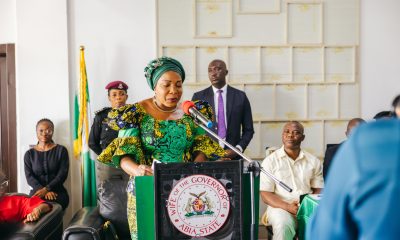
Speaking during signing ceremony held at Government House, Umuahia, Otti thanked State House of Assembly, Judiciary and stakeholders for thorough work on the bills, saying what he saw in the drafts was satisfactory.
Otti said the existence of law and enforcement are two different things, assuring that his administration has the political will to ensure laws are respected to ensure orderly society.
“Sometimes we find it difficult to implement some of the things we have in mind because when you check the law, you find law does not allow you to implement strict consequence management,” Otti said.
Citing an example of narcotics, he said the current national laws treat drug use lightly while focusing on trafficking, noting that “if there are no buyers, there won’t be sellers.”
Otti argued that when laws are respected, society functions like clockwork, recalling how traffic collapsed in a U.S. city when traffic lights failed due to blackout.
On ABSU law, the Governor said moving faculties back to Uturu was to avoid duplication of costs and take advantage of shared services and ongoing investments, with only the Teaching Hospital retained in Aba.
Earlier, Attorney-General and Commissioner for Justice, Barr. Ikechukwu Uwanna, presented brief on the bills, saying three justice laws together address what conduct law prohibits, how criminal cases should be handled and how harm caused by crime may be repaired.
Uwanna said reforms respond to public concerns over cultism, kidnapping, vandalisation of public infrastructure, sexual violence and delay in criminal proceedings.
According to him, Criminal Law Bill strengthens response to cultism beyond school campuses to communities, provides specific sanctions for vandalisation and stealing of public assets such as transformers, poles and streetlights, and strengthens protection against rape, sexual assault, sexual harassment and spousal violence, recognizing both male and female victims and providing for sex offenders register.
The Bill also covers kidnapping, child exploitation, corporate responsibility and offences involving electronic records and digital assets, and broadens sentencing options to include restitution, compensation, rehabilitation and community service.
He said the Administration of Criminal Justice Bill provides procedure for enforcement, addresses arrest, bail, remand, trial and sentencing with safeguards for suspects and victims, prohibits arresting one person in place of another and using arrest to pursue civil disputes or debt recovery.
According to him, the Restorative Justice Bill gives structure to repair of harm in eligible cases where victims and offenders participate voluntarily to address responsibility, reparation and reintegration, with exclusions for capital offences, kidnapping, terrorism, corruption and financial crimes.
Uwanna insisted that no victim should be pressured to accept agreement and the process must operate under safeguards.
He added that the next task is implementation, circulation, translation to Igbo language and training of stakeholders.
With assent, Abia now has new criminal code, modern criminal procedure regime and restorative justice framework aimed at safer society, better community relations and renewed confidence in the justice system.