
ECONOMY
Otti Presents ₦1.2 Trillion 2027 Budget to Abia Assembly

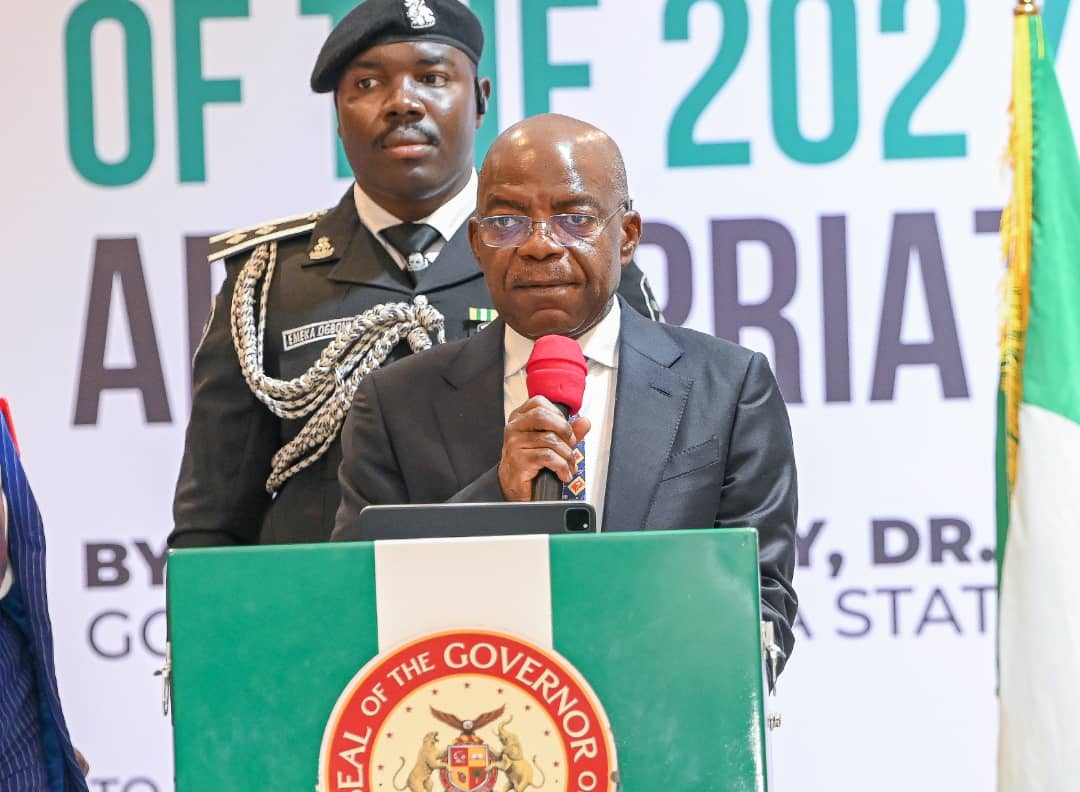
UMUAHIA — Governor Alex Otti on Thursday presented a total budget estimate of ₦1.2 trillion for the 2027 fiscal year to the Abia State House of Assembly.
The appropriation bill is christened “Delivering Today, Energizing Tomorrow.”
Presenting the bill, Otti said of the ₦1.2 trillion, ₦647.33 billion shall be raised from internal and external revenue channels — including Internally Generated Revenue, statutory allocation (FAAC), Value Added Tax (VAT), other federal revenue sources and recurrent grants.
The balance of ₦552.67 billion shall be sourced through concessional loans and committed strictly to infrastructure projects with regenerative value.
He said the projected IGR component for the coming fiscal year is estimated at ₦199.8 billion, which if actualized, will be enough to cover more than 80 percent of recurrent costs.
The 2027 budget pack represents an *18 percent increment* from the ₦1.016 trillion presented for 2026 — the first time in history Abia’s budget envelope hit the 13-digit mark.
It also represents a massive jump from the ₦567.2 billion presented in his first budget in December 2023, and from the ₦160.5 billion budgeted in the previous year before he took office.
Otti recalled that his first full-year budget in 2024 represented a 253.4 percent increase from the previous year, with 84 percent earmarked for capital spending and 16 percent for recurrent.
In 2025, he presented a ₦750 billion budget with capital allocation at 82 percent.
In keeping with his culture of fiscal discipline, Otti said 80 percent of the entire 2027 budget — ₦960 billion — is committed to capital expenditure, leaving the remaining 20 percent for recurrent expenditure.
Otti said his governance philosophy prioritises human capital development, necessitating the commitment of 35 percent of the 2027 fiscal outlay to education and health.
Basic, secondary and tertiary education will receive 20 percent of the total envelope, while the health sector gets 15 percent, consistent with the Abuja Declaration of 2001.
He said this framework has been the standard over the last three years.
In terms of broad sectoral allocation:
– 55 percent of the proposed ₦1.2 trillion is earmarked for the broad economic sector — agriculture, works, transportation, petroleum and solid mineral development, power and public utilities, the three regional development authorities, land administration, arts, culture and creative economy, digital capacity development, industries and SMEs.
– 37.2 percent is projected for the social sector, covering recurrent and capital development initiatives in ministries.
– 5.1 percent will go to the administrative sector.
– Law and Justice is proposed to receive ₦17.3 billion for the smooth running of its operations.
Otti told the Assembly that through prudent application of funds appropriated over the last three years, the administration has constructed over 1,000 kilometres of roads across the 17 LGAs, with more than 80 other road projects spanning over 200 kilometres still ongoing.
He said the state has reduced its public debt profile by around 60 percent from 2023 figures, recruited thousands of new workers in education and health, and subsidizes public transportation through the Green Shuttle Bus Services by as high as 60 percent on some routes.
He also said the health sub-sector, to which 15 percent of annual budgets have consistently been allocated, is witnessing rising public confidence, with new tertiary health facilities being developed in Amatera and Omonato, and the Abia State University Teaching Hospital in Aba being reconstructed and expanded.
Responding, the Speaker of the House, Emmanuel Emeruwa assured that the Assembly will give the budget expedited but thorough action.
“We will always give an expedited action, though we have to be thorough. We have to do the detailed job to make sure that everything falls in line, but we will give it a speedy discussion,” he said.
He urged MDAs to cooperate and be ready to defend their budgets day and night so the budget can be passed before the end of the year.