
EDUCATION
Ajagba Charges ASLA Participants to Reset their Minds, Prepare for Responsible Leadership

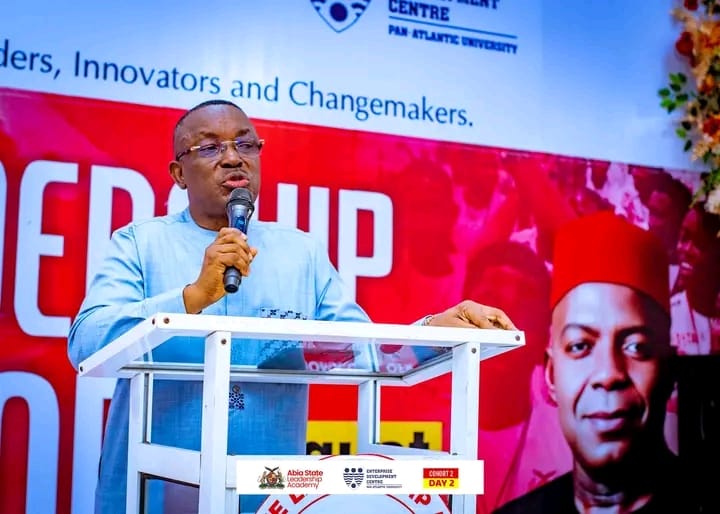
Chief of Staff to the Governor, Pastor Caleb Ajagba, has challenged participants of the Abia State Leadership Academy to change their mindset and prepare themselves for responsible leadership.
Ajagba spoke on Sunday at Government College during his presentation on “The Demands of Faithful Stewardship” at the Leadership Breakfast Series.
According to him, Africa’s biggest problem is not a lack of natural resources but a failure of leadership.
He maintained that Africa is richly blessed with natural resources, yet many of its countries continue to struggle because of poor leadership and weak management of available resources.


 He noted that Africa often exports raw materials, which are processed into finished products in other parts of the world and later sold back to Africans at much higher prices.
“Africa today is not poor because it doesn’t have resources, but because of poverty of leadership,” Ajagba said.
He said the difference between prosperous and struggling societies often lies in the quality of leadership, stressing that visionary, faithful and purposeful leaders build great nations.
“Nations prosper because of visionary, faithful and purposeful leaders. Greed and corruption thrive where faithfulness and integrity are absent,” he said.
Ajagba described the establishment of the Abia Leadership Academy as a deliberate effort to help young people reshape their thinking, discover their potential and prepare for future responsibilities.
 He urged the participants to believe in themselves and refuse to see themselves as disadvantaged.
“The same brain you have is the same brain other people have. You are supposed to be flying, not crawling,” he told the youths.
Drawing from 1 Corinthians 4:2, Ajagba explained that leadership is essentially about stewardship and that anyone entrusted with responsibility must be faithful and ready to give an account of how such responsibility was handled.
“A steward is someone entrusted to manage another’s resources, responsibilities or property on their behalf.
“Stewardship is not ownership. Every steward will one day give an account,” he said.
He explained that leadership does not begin only in government or public office but in the little responsibilities entrusted to individuals at home, in school and in their communities.
Ajagba identified responsibility, integrity, faithfulness, accountability and trustworthiness as some of the qualities every leader must possess, warning participants against eye service and dishonesty.
“A faithful steward takes ownership of his duties and delivers on commitments, regardless of who is watching,” he said.
He also warned young people against allowing peer pressure to influence them into crime, corruption and other destructive habits, saying faithfulness and discipline would eventually distinguish them in life.
“Twenty children can play together for twenty years, but after twenty years, go and find out where all of them will be. Time will tell the whole story,” he said.
Speaking on vision, Ajagba urged the participants to discover their individual purpose and pursue it with determination instead of living their lives by copying others.
“You are original. Don’t copy another person,” he said.
Also speaking, facilitator from the Enterprise Development Centre of Pan-Atlantic University, Dr. Uchendu Egbuna, explored the meaning of leadership, making a clear distinction between leadership and authority.
“Leadership is not authority,” he told the participants does not automatically make a person an effective leader, he said.
He emphasised on the importance of preparation, warning that planning alone cannot guarantee results.
“Planning without preparation will not get you to that goal.
“Most times, the challenge is not because we don’t know what to do, but because we don’t prepare ourselves when it is time to take action,” he said.
In his session, Dr. Christian Uche Anokwuru, Special Adviser to the Governor of Abia State on Policies and Interventions, explained that virtue is built through daily choices and habits, urging participants to practise honesty, courage and kindness even when no one is watching.
Drawing from the ideas of Aristotle, another lesson stressed that greatness is not a matter of luck but the result of consistent decisions and actions.
“Greatness is not a lucky break. It is a habit, built one small decision at a time.
“Leadership is a call to serve, not to shine,” he said.
Anokwuru added that power and position should be used to protect and serve people rather than to impress others.
In the last session, Director General/Chief Executive Officer, Public Private Partnership and Investment Promotions Office, Chinedum Chijioke, everyone must build a positive mindset and believe in their ability to succeed.
“You must maintain a positive mindset that any and everything is possible if I apply myself,” he said.
He also encouraged students to focus on understanding what they study rather than relying entirely on memorisation.
“Beyond cramming, understanding is what you are after,” he said.
Emphasizing on the temptation to abandon a skill, business or career path because results are slow, he reminded the participants that success and mastery take time.
“Every expert was once a beginner, but that expert stayed on it,” he said.
He warned against the desire for instant success, urging the young people to be patient and consistent.
“Pick it, stay on it, even when you don’t see results. Give it time; the difference will come,” Chijioke concluded.
The Senior Special Assistant to the Governor on Public Communication Mr Dodoh Okafor was present during the Leadership Breakfast Series.