NEWS
Abia PWDs Urged To Vote In Forthcoming Elections As Advocates Call For Inclusive Polls


Group Says Disability Is A Human Right Issue, Not Charity, Demands Better Access At Polling Units
UMUAHIA, Abia State – Persons with disabilities in Abia State have been urged to come out en masse to vote in the forthcoming elections, with disability rights advocates stressing that physical condition should not be a barrier to civic participation.
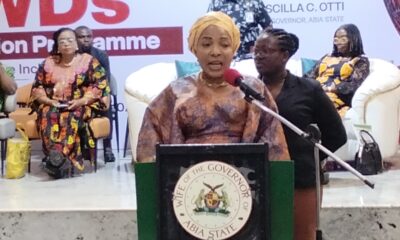
The call was made during a sensitisation programme on the inclusion of persons with disabilities in the electoral process organized for PWDs in Umuahia South Local Government Area.
Speaking at the event, Joan Oluchi Irozuru, General Secretary of the Persons With Disabilities group in Umuahia South LGA, encouraged members to exercise their civic responsibilities.
“Everybody should come out. Nobody should feel that he is not recognised. We should come together and put our efforts. We should not think that this condition will make us unavailable when things are happening. We should be inclusive,” she said.
Irozuru noted that PWDs are important members of society with equal rights to participate in political and electoral activities.
She acknowledged government efforts to improve accessibility, citing the provision of ramps in public facilities for wheelchair users and hearing aids for persons with hearing impairment.
“Government has really tried because persons with disabilities, when they want to go up in a situation where there is a step, there is a ramp that will help you to move,” she said.
She, however, called for continued inclusion and greater awareness to ensure no PWD was left behind.
A disability rights advocate at the programme, Terfa Tyokase, challenged discriminatory attitudes and misconceptions against PWDs, describing disability as a human rights issue rather than charity or a religious problem.
“Disability is not charity. Disability is not about religious issues. Disability, you have the right to be respected. You have the right to vote. You have the right to be voted for,” he declared.
He condemned beliefs that associate disability with sin, referencing John Chapter 9 in the Bible, and recounted instances where PWDs face stigma in public offices.
“Once they see a person with disability, they say he is coming to beg. They don’t look at a person with disability as someone that is already a man” he said.
Citing the Governor of Akwa Ibom State and Ambassador Jekpele of TAP Africa as examples, he stressed that disability has never been a barrier to leadership and public service.
The advocate urged PWDs to pursue political power actively, noting their numerical strength.
Quoting WHO estimates, he said PWDs constitute about 16% of the global population — over 1.6 billion people. In Nigeria, he said about 65% of PWDs are 18 years and above, making them a significant voting bloc.
Comparing this to 2023 presidential results — APC 8.9m votes, PDP 7m votes, LP 6m votes — he said a united disability community could influence electoral outcomes.
“Power can never be given. You must go out and contest and win,” he added.
Another advocate identified poor accessibility, communication challenges, institutional limitations and inadequate disability data as major barriers to effective participation.
He said while INEC has trained ad-hoc staff on disability inclusion, implementation at polling units remains weak.
He cited polling units located in inaccessible areas and poor arrangement of tables and ballot boxes as challenges for wheelchair users.
“How do you expect a wheelchair user to wheel his or her chair up this place and cast his vote?” he asked.
He also raised concerns about communication gaps for the hearing impaired, the need for sign language interpreters, and the fact that INEC’s disability data collection started in 2022.
He urged PWDs who registered before 2022 to update their status to enable INEC to provide assistive devices.
Other issues highlighted include lack of public awareness about the right of PWDs to priority voting, and difficulties faced by persons with visual impairment in voting independently.
The advocates called for continuous sensitisation of the public and electoral officials, and for practical solutions to ensure elections are accessible to all.
They maintained that ensuring inclusive elections is not benevolence but a responsibility grounded in the fundamental rights, dignity and equality of persons with disabilities.