
HEALTH
Abia First Lady Enrols Persons With Albinism, Sickle Cell Warriors In Health Insurance Scheme


Distributes N50,000 each as immediate support, pledges skills, economic empowerment; says inclusion must outlive outreach
UMUAHIA — Wife of Abia State Governor, Mrs. Priscilla Otti, has facilitated the enrollment of persons with albinism and sickle cell warriors into the Abia State Health Insurance Scheme to ensure continuous access to healthcare beyond one-off outreaches.
Mrs. Otti announced this on Thursday during the Care and Fare Outreach Day for Persons with Albinism and Sickle Cell Warriors tagged “One Tent, Two Causes” in Umuahia.
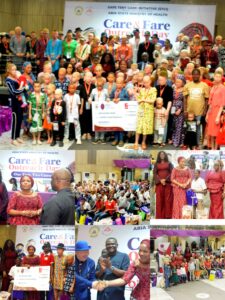
She said each beneficiary would also receive N50,000 as immediate support, while being linked to health institutions for regular care, eye and vision support, counselling and referrals.
“Today is about care, inclusion and dignity. But most importantly, it is about building support that continues long after we leave this hall,” she said, noting that the most impactful outreach is one whose impact continues to be felt after the event.
The First Lady, speaking through her Safe Tent Care Initiative, SCTI, said her approach is anchored on three words — community, consistency, collaboration — explaining that government must listen to actual needs, sustain support, and partner with institutions rather than duplicate services.
She said persons living with sickle cell condition need regular healthcare and continuity of care, while persons with albinism require skin care, sun protection, eye examination, health education and timely medical attention, adding that stigma and barriers to opportunity must be confronted.
Mrs. Otti said support will not stop at healthcare, pledging to include members of both communities in skill acquisition, livelihood and economic empowerment programmes.
“You are not defined by a medical condition. You have talents, dreams, businesses to build, careers to pursue, and families to support. Our commitment is help for today, a pathway for tomorrow,” she stated.
Mrs. Otti recalled her meeting with the communities in January where she assured them of support, saying Thursday’s event reinforces that commitment.
She particularly acknowledged Ambassador Dr. Jake Epelle, founder and CEO of TAF Africa, for transforming his experience with albinism into advocacy for disability inclusion in healthcare, education, economic opportunity, governance and political participation, as well as electoral inclusion.
Mrs. Otti thanked the Ministry of Health, health professionals, Safe Tent Care Initiative team, Office of the Wife of the Governor, partners and volunteers for making the outreach possible.
Founder and CEO of TAF Africa, Ambassador Jake Ekpelle, in a keynote address, described Mrs. Otti as Voice of the Voiceless, noting that the event showed health condition must not become basis for discrimination, poverty or exclusion and called for a shift from sympathy to systems and from occasional outreach to sustained access to care.
He commended Governor Alex Otti for standing with rejected and neglected persons and for supporting his wife’s humanitarian initiatives, describing their partnership as model, while noting his apolitical stance does not stop him from speaking truth.
Delivering a health talk on sickle cell, a consultant paediatrician with Federal Medical Centre, FMC Umuahia, Dr. Izuka said sickle cell is serious but not a death sentence and that warriors can live long, healthy and productive lives with right care and active participation in managing their health.
In her presentation on albinism, Mrs. Betty Emeka-Obasi corrected the use of “albinos” to “persons with albinism,” explaining that albinism is reduced melanin in the eyes and skin causing reduced visual acuity, nystagmus, photophobia, strabismus and underdeveloped retina.
She advised parents to ensure eye testing immediately after birth by a pediatric ophthalmologist and annually thereafter, noting that refractive errors like myopia and astigmatism can be corrected early to prevent degeneration.
She urged schools to seat children with albinism in front, closer to the blackboard, and advised use of amber UV-protective lenses and wide-brim hats, stressing that the condition does not limit potential.
Speaking on inclusion, Chairman of the Welfare of Persons with Disability Abia state, Dr. David Anyaele described Governor Alex Otti as disability-inclusive, noting that persons with disabilities who in the past protested without recognition are now being recognized and included in governance.
The Commissioner for Health, Prof. Enoch Uche, sid the Abia State Government is prioritizing the healthcare, comfort and wellbeing of persons living with albinism and sickle cell condition.
Dr. Uche said the programme is important because it focuses attention on people often marginalized or overlooked, stressing that disability and health conditions should not be viewed as weakness but as opportunities to turn vulnerability to strength.
The Commissioner announced that a health insurance programme has been put together for persons living with albinism and sickle cell condition, with beneficiaries to be enrolled to access services from designated providers without direct payment at point of care, implemented through Mrs. Otti in collaboration with Ministry of Health and Abia State Health Insurance Agency.
He encouraged affected persons and families to use available support and work with professionals for proper diagnosis and treatment, reaffirming government commitment to equity and inclusion so that no one is left behind in accessing quality healthcare.
Also speaking, the Commissioner for Women Affairs, Dr. Maureen Aghukwa, commended the wife of the Governor, Mrs. Priscilla Otti, for her compassion and advocacy for vulnerable and underserved groups, saying the initiative shows no one should be left behind in pursuit of a healthier, more inclusive society.
She said persons living with albinism deserve dignity, acceptance, protection and equal opportunities, stressing that stigma, discrimination, bullying and misconceptions must be challenged and should not be a barrier to education, employment, healthcare or full participation.
On sickle cell, she emphasised knowledge, early diagnosis, proper healthcare, genetic counselling and sustained family support, urging the public to make awareness continuous in homes, schools, workplaces and worship centres.
